
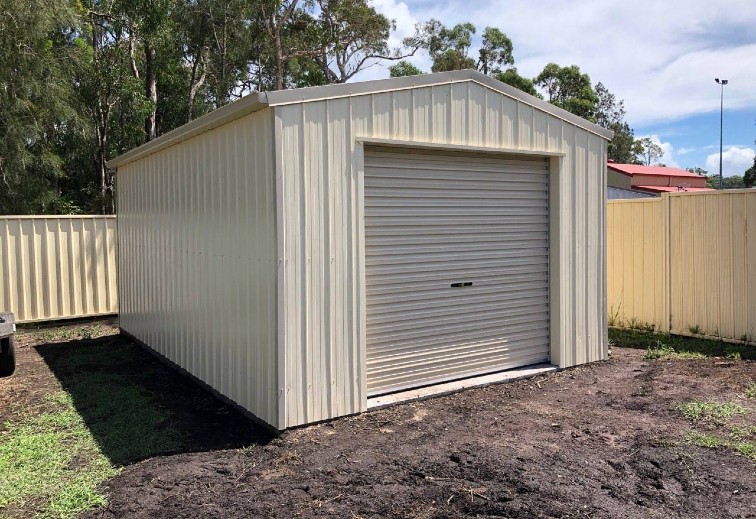
Most of the questions we get asked about a new shed are about the building itself: the size, the doors, the colour. The part that catches people out is what happens before the shed turns up, because that is where a build either runs smoothly or stalls for a month.
Here is what actually has to be sorted on your block, in the order it matters.
Where the shed sits is a decision, not a default
The obvious spot is not always the right one. Before anything is drawn we look at how you will get a vehicle to the doors, where the water goes when it rains hard, how far the building sits from boundaries, and what it will look like from the house and the street.
Access is the one people underestimate. A shed has to be delivered and built, which means a truck and a crew need to get to the site. On a tight block, or a rural property with a soft track, that is worth working out before the design is finalised rather than on the day.
Drainage and the fall of the land
Water is the thing that ruins sheds, and it rarely arrives through the roof. It comes in under the walls because the ground falls towards the building or because the pad sits lower than the surrounding dirt.
On a sloping site you have a choice between cutting into the slope, building the pad up, or stepping the design. Each has a cost and each changes the engineering, so it is a conversation to have early. Where the water will go once the shed is there is part of the same question, because a roof is a large catchment and it has to drain somewhere sensible.
The slab
Most sheds sit on a concrete slab, and the slab is engineered for the building that goes on it rather than poured to a standard thickness. A machinery shed carrying a loaded tractor is not the same as a single garage. What you intend to park inside, and what you might park inside later, changes the specification.
The sequence matters too. The slab needs to be right before the frame arrives, and the building is set out from it, so a slab poured to the wrong dimensions is an expensive week.
Services
Power, water and drainage are much cheaper to run before the slab goes down than after. Even if you are not fitting the shed out immediately, putting a conduit in while the ground is open costs very little and saves cutting concrete later.
It is worth deciding at this point whether the building is ever going to be a workshop, a studio or accommodation, because that changes what you want to allow for.
Approvals run alongside all of this
Most sheds of any real size need approval, and whether that is exempt development, complying development or a full development application depends on the size, the height and the position on your block. We prepare the documentation and lodge it, and the engineering we supply is what the assessment is based on. Our guide to council approval for sheds goes through it in more detail.
Approval usually takes longer than the build, which surprises people. It is the main reason a shed that is wanted by Christmas needs to be started well before it.
The order that works
Design and quote first, so the building is settled. Then engineering and approval, because the documentation depends on the final design. Then site preparation and the slab. Then delivery and install.
Trying to do the site work before the design is settled is the common false economy. A pad in the wrong place, or the wrong size, is a cost with nothing to show for it.
What we need from you
Realistically, three things. What is going inside, including the tall things. Where you want it, or at least a rough idea. And whether the block has anything unusual about it: a slope, poor access, a boundary issue, or a services run in an awkward place.
Everything else we can work through. We have been supplying sheds in Nowra and across the Shoalhaven from our South Nowra yard since 1987, and site conditions around here are not a mystery to us.
Talk it through before you commit
If you are at the stage of thinking about a shed, the most useful thing you can do is have the conversation before the ground is touched. Take a look at the range of sheds we supply, then get in touch for a quote and we will work through your site with you.